Emotion-Aware
Artistic Generation
Bridging the gap between visual art and emotion understanding with 132,000+ annotated artworks and multidimensional analysis.
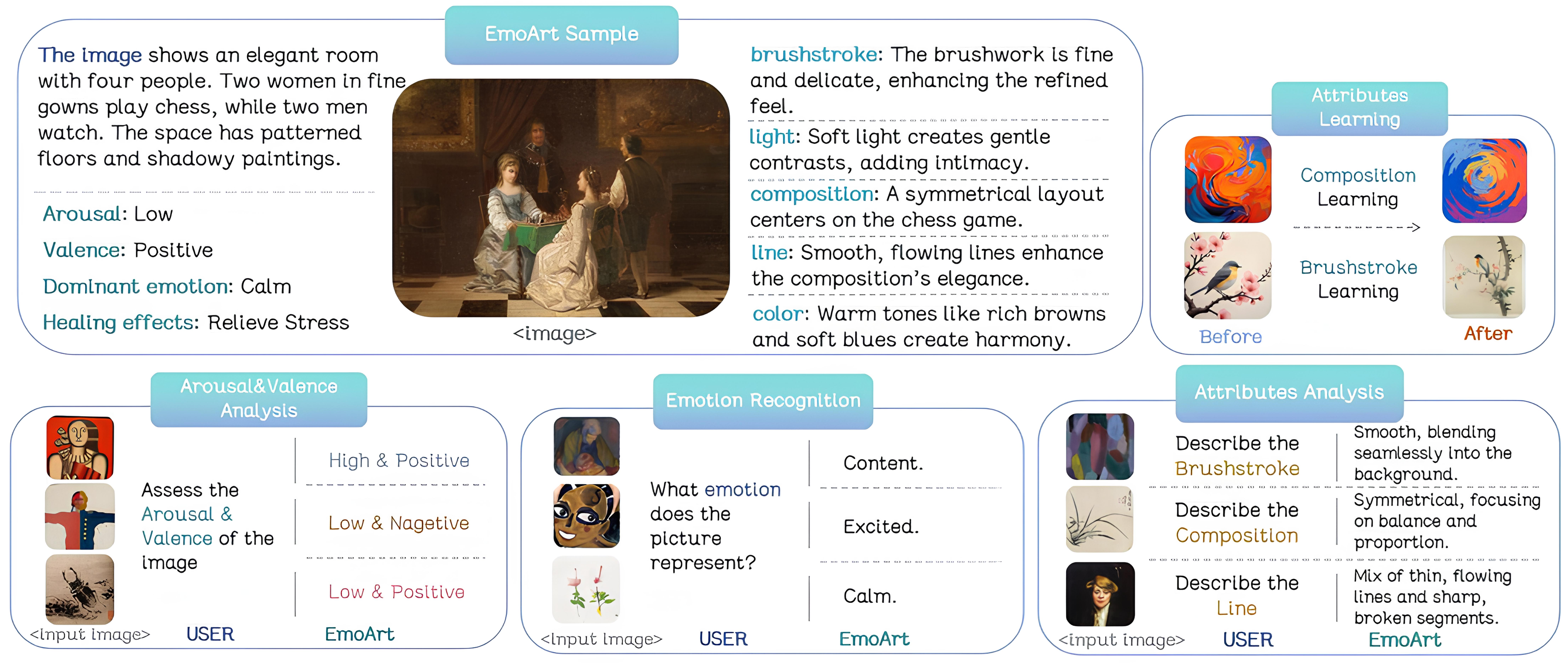
Why EmoArt?
A pioneering large-scale dataset capable of powering the next generation of affective computing and creative AI.
Comprehensive Collection
Spanning Western and Eastern traditions, from Renaissance masterpieces to contemporary abstract movements.
GPT-4o Annotations
Rich, multi-dimensional annotations generated by advanced AI and validated by humans with >85% agreement.
Emotional Depth
Covering 12 representative emotions across the full valence-arousal spectrum for nuanced understanding.
Visual Analysis
Structured decomposition of Brushwork, Composition, Color, Line, and Light.
FAB-G Salience Extension
A compact human-validated extension for attribute-grounded artwork emotion reasoning.
Attribute Salience
EmoArt-Salience annotates which formal attributes are emotionally operative for each artwork, separating cues that are merely visible from cues that support the affective judgment.
Five Formal Cues
The salience labels cover Color, Composition, Line, Light, and Brushstroke, matching the FAB-G attribute-agent vocabulary used for selective reasoning.
FAB-G Pipeline
FAB-G first predicts salient attributes with specialized agents, then sends only the selected attributes to the final agent for cue-constrained emotion analysis.
Benchmark Performance
Evaluating state-of-the-art text-to-image diffusion models.
| Model | Overall Quality | Emotion Alignment | Color | Composition | FID ↓ |
|---|---|---|---|---|---|
| FLUX.1-dev-lora | 0.6604 | 0.6698 | 0.6974 | 0.6698 | 31.65 |
| FLUX.1-dev | 0.6392 | 0.6450 | 0.6503 | 0.6450 | 21.29 |
| PixArt-sigma | 0.6505 | 0.6342 | 0.6746 | 0.6342 | 36.64 |
| Playground | 0.6486 | 0.6247 | 0.6788 | 0.6247 | 42.57 |
| SD3.5 | 0.4350 | 0.6324 | 0.3420 | 0.4324 | 37.96 |
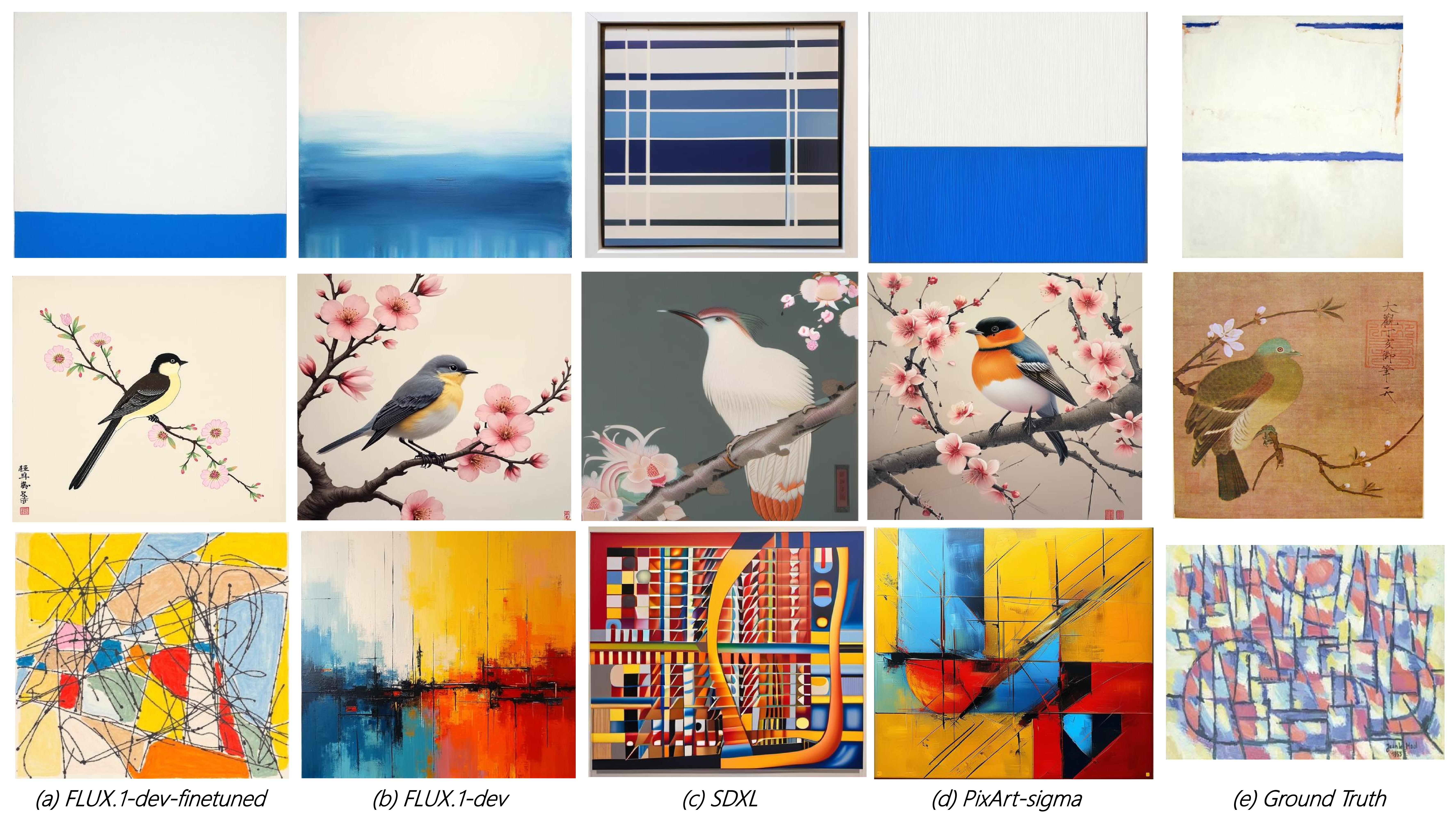
Visual Analysis
- Color Field Painting: FLUX.1-dev-finetuned uses pure blue and white blocks to create a calming atmosphere, capturing the essence of Color Field Painting perfectly.
- Traditional Chinese Painting: The fine-tuned model employs minimalist compositions and soft brushwork, conveying the serenity typical of East Asian aesthetics.
- High-Arousal Emotions: For intense emotions, the model effectively utilizes chaotic line work and asymmetric compositions.
Dataset Composition
A deep dive into the artistic styles and emotional distributions.
Detailed Statistics by Style
| Art Style | Entries | Arousal Distribution | Valence Distribution | Dominant Emotions |
|---|---|---|---|---|
| Abstract Art | 1,759 | High: 51.5% / Low: 48.5% | Pos: 93.5% / Neg: 6.5% | Excited (47%), Calm (39%) |
| Abstract Expressionism | 3,674 | High: 58.7% / Low: 41.3% | Pos: 85.7% / Neg: 14.3% | Excited (47%), Calm (31%) |
| Baroque | 7,995 | High: 21.4% / Low: 78.6% | Pos: 86.2% / Neg: 13.8% | Calm (55%), Contentment (19%) |
| Impressionism | 11,736 | High: 9.9% / Low: 90.1% | Pos: 95.4% / Neg: 4.6% | Calm (67%), Contentment (20%) |
| Realism | 15,307 | High: 8.0% / Low: 92.0% | Pos: 88.9% / Neg: 11.1% | Calm (65%), Contentment (20%) |
| Expressionism | 10,065 | High: 36.2% / Low: 63.8% | Pos: 75.9% / Neg: 24.1% | Calm (42%), Excited (21%), Sad (11%) |
| Chinese Painting | 4,157 | High: 0.2% / Low: 99.8% | Pos: 99.9% / Neg: 0.1% | Calm (89%), Contentment (10%) |
| Ukiyo-e | 1,730 | High: 13.9% / Low: 86.1% | Pos: 95.2% / Neg: 4.8% | Calm (74%), Contentment (11%) |
| Full statistical breakdown available in the dataset documentation. | ||||
Citation
If you use EmoArt in your research, please cite our paper.